I’m a front end developer at Equinox OLI, working on open source library software. I was previously a freelance WordPress developer in higher education. You can get in touch here or on LinkedIn.
Previously: WordPress Consulting
I worked with clients, mostly in higher education, who need custom search interfaces for multiple data types. I helped them set up automated data imports from external sources or APIs, remediate the incoming metadata, and create customized WordPress authoring interfaces tailored to their data models. Whether we needed to create a new theme or design the site to match institutional branding, I designed a custom search interface to take full advantage of the available metadata.
Prior to striking out on my own in 2012, I worked for the Texas A&M University Writing Center, the Texas A&M System Offices, and the Texas A&M Health Science Center. For several years, I also had a sideline in building websites for authors.
In addition to WordPress, I specialized in responsive CSS design, web standards and accessibility compliance, website governance and content strategy, and teaching in-house staff to write for the web. For projects not based in WordPress, I have worked as a user interface designer and user experience advocate in conjunction with in-house software development teams.
WordPress Books
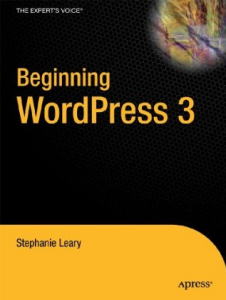
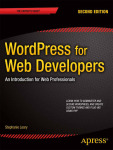
I’ve written a book for web professionals who are new to WordPress, Beginning WordPress 3, published in June 2010 by Apress. The second edition, titled WordPress for Web Developers, came out in 2013, with significant changes and additions.
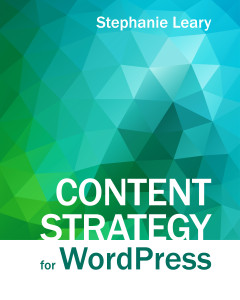
My third book, Content Strategy for WordPress (2015), is for site owners of all backgrounds, not just web developers. It describes how to implement specific content strategy tactics, like content inventories and editorial calendars, using WordPress features and plugins.
Conference Talks and Other Publications
I’ve also published over twenty free WordPress plugins. Most of my themes have been proprietary client or day-job projects, but I have published a couple of theme demos from the book. You can also find WordPress tips on my blog.
From 2004-2016, I spoke regularly at conferences, primarily HighEdWeb, WordCamps, and WPCampus. I was on the programming committee for the HighEdWeb conference from 2006 until 2009. With Shelley Keith, I was in charge of programming for WPCampus Online for its first couple of years. I have also spoken at BookExpo America on software platforms for book bloggers.
See all my presentations and interviews.
Changing Directions: Library & Information Science
By 2019, I’d been working side by side in government/education and publishing for a while. I decided to combine the two interests and go to library school. I wanted to learn how to transfer my skills in taxonomies, data modeling, and user interface design to the complicated world of bibliographic metadata, with a particular interest in the classification of fiction.
I enrolled in the University of Washington iSchool‘s MLIS program, where I researched how library users find LGTBQIA+ materials in the catalog, the history of fiction classification schemes, and how text mining methods could be used to glean bibliographic relationships from book reviews and author interviews. Course highlights include cataloging, classification theory, metadata design, taxonomy and ontology construction, Indigenous knowledge organization, adult fiction genres, readers’ advisory, library technical services, information retrieval, text mining, and machine learning and ethics in AI.
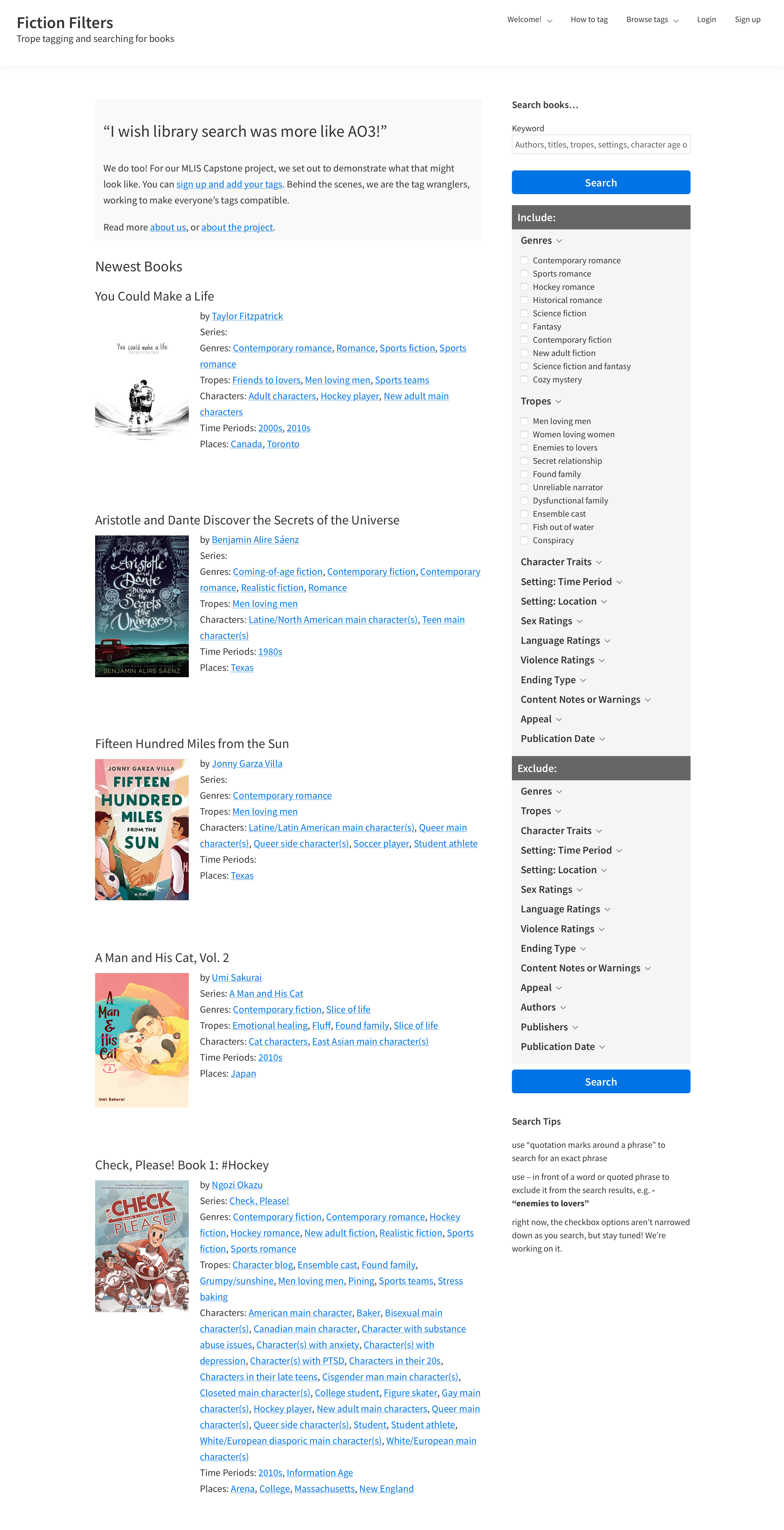
For my capstone team project, I built a crowdsourced tagging site for novels that allows users to search based on subgenres, tropes, character traits, and settings, with filters for content warnings and ratings for sex, language, and violence. Using a tag wrangling process inspired by the Archive of Our Own, we demonstrated how curating user-submitted tags into a detailed controlled vocabulary could improve library metadata and search interfaces. While we focused on fiction, the workflow could be applied to any domain where it is difficult for catalogers to supply the metadata necessary to meet users’ search needs.
During my last year in the program, I worked closely with the faculty to review the technical core curriculum. Our final report is not yet public, but has resulted in a number of changes to the six technical courses. One part of the project is available: the recommendations for incorporating social/ethical topics into the tech courses.